
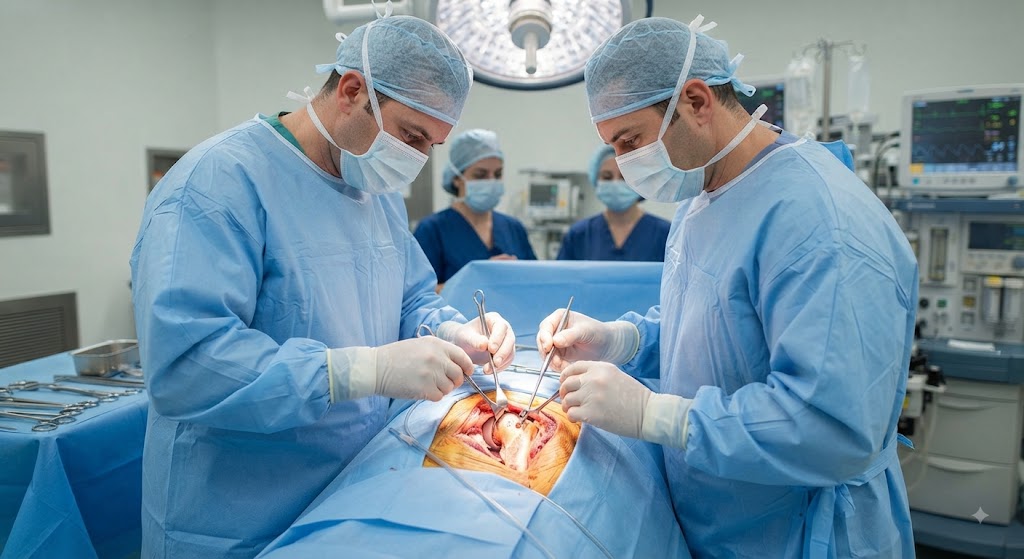
Shoulder Replacement Surgery by Brit Indo Medical Concierge
Shoulder replacement surgery, also called shoulder arthroplasty, is an established treatment for patients with severe shoulder joint damage, advanced arthritis, certain complex fractures and selected cases of irreparable rotator cuff damage. The procedure replaces damaged parts of the shoulder with artificial components to help reduce pain and improve shoulder function.
The shoulder is a ball-and-socket joint. Depending on the condition of the joint and the rotator cuff, an orthopaedic shoulder specialist may recommend total shoulder replacement, reverse shoulder replacement, partial shoulder replacement or revision shoulder replacement.
Brit Indo Medical Concierge helps international patients explore shoulder replacement surgery in India by coordinating specialist consultations, hospital arrangements, treatment estimates, medical travel, accommodation and related non-clinical services.
What Is Shoulder Replacement Surgery?
- Shoulder replacement surgery involves removing damaged parts of the shoulder joint and replacing them with artificial components.
- The main goals are to reduce chronic shoulder pain, improve movement and help the patient perform everyday activities more comfortably.
- The operation is also known as shoulder arthroplasty.
- Depending on the condition, the surgeon may replace the entire joint or only part of it.
- The type of implant depends on factors such as shoulder arthritis, bone quality, rotator cuff condition, age, activity level and previous surgery.
- Unlike knee or hip replacement, the condition of the rotator cuff is particularly important when choosing the appropriate shoulder implant.
- Shoulder replacement should generally be considered after a specialist evaluation and when appropriate non-surgical treatments have not provided adequate relief.
Who Needs Shoulder Replacement Surgery?
A patient may be considered for shoulder joint replacement when severe pain and loss of shoulder function significantly affect quality of life.
Common reasons include:
- Severe shoulder osteoarthritis causing persistent pain and stiffness.
- Rheumatoid arthritis or other inflammatory joint conditions.
- Advanced cartilage loss and deterioration of the shoulder joint.
- Severe shoulder pain that interferes with sleeping.
- Difficulty lifting or moving the arm.
- Loss of shoulder movement affecting dressing, bathing, cooking or other daily activities.
- Complex fractures around the upper end of the arm bone that cannot be adequately repaired.
- Irreparable rotator cuff tear associated with severe joint dysfunction.
- Previous shoulder surgery that has resulted in significant joint damage.
- Failure of conservative treatments such as medicines, physiotherapy, activity modification or injections.
The decision should not be based on age alone. The surgeon considers the patient’s symptoms, medical history, imaging, bone quality, rotator cuff function and overall health before recommending surgery.
Types of Shoulder Replacement Surgery
Total Shoulder Replacement
- Total shoulder replacement, also called anatomic total shoulder arthroplasty, replaces both major damaged joint surfaces.
- The damaged humeral head is replaced with an artificial ball component.
- The damaged glenoid, or socket, is resurfaced with an artificial component.
- This procedure may be appropriate for patients with severe arthritis when the rotator cuff is functioning adequately.
- The objective is to reduce pain and restore useful shoulder movement.
Reverse Shoulder Replacement
- Reverse shoulder replacement changes the normal arrangement of the shoulder joint.
- The artificial ball is attached to the shoulder blade side, while the socket component is placed on the upper arm side.
- This design may be recommended for selected patients with irreparable rotator cuff tears, cuff-tear arthropathy or certain complex fractures.
- It allows different muscles, particularly the deltoid, to contribute to raising the arm when the rotator cuff cannot function normally.
- Reverse shoulder arthroplasty has become an important option for appropriately selected patients.
Partial Shoulder Replacement
- Partial shoulder replacement, or hemiarthroplasty, replaces primarily the damaged humeral head.
- The natural socket may be retained.
- It can be considered in selected fractures or particular conditions where the glenoid surface remains suitable.
- The surgeon decides whether partial or total replacement is more appropriate after examining the joint.
Shoulder Resurfacing
- Shoulder resurfacing replaces or resurfaces the damaged humeral head rather than using a conventional stemmed implant.
- It may be appropriate for selected patients with suitable bone quality and specific joint conditions.
- It is not suitable for every patient.
Revision Shoulder Replacement
- Revision shoulder replacement surgery is performed when an existing shoulder replacement develops a significant problem.
- Reasons may include implant loosening, instability, infection, fracture, wear or persistent dysfunction.
- Revision surgery can be more complicated than primary shoulder replacement and requires detailed specialist planning.
Shoulder Replacement Surgery Cost: India vs UK vs USA
The shoulder replacement surgery cost varies according to the procedure, implant, hospital, surgeon, city, length of hospital stay and patient’s medical condition.
Current published 2026 sources place private shoulder replacement treatment in India broadly in the US$4,500–$10,000 range, although individual hospital estimates can be outside this range. Published comparison figures for the UK and USA are considerably higher.
| Country | Approximate Private/Self-Pay Cost |
|---|---|
| India | US$4,500–$10,000 |
| UK | US$14,000–$40,000 |
| USA | US$25,000–$55,000+ |
- In India, one 2026 published guide reports approximately US$5,000–$10,000, depending on the procedure and hospital.
- Another current Indian source reports shoulder replacement costs of approximately ₹3 lakh–₹7 lakh, depending on the procedure and location.
- Published international-patient comparisons place US treatment around US$30,000–$60,000 and UK private treatment around US$14,000–$25,000, although actual quotations can vary significantly.
These figures are indicative only, not guaranteed treatment quotations.
What Affects Shoulder Replacement Cost?
The final shoulder replacement cost in India may depend on:
- Type of shoulder replacement.
- Total versus reverse versus partial replacement.
- Implant brand and model.
- One-time versus revision surgery.
- Surgeon’s experience.
- Hospital infrastructure.
- City and hospital location.
- Operating-room and anaesthesia charges.
- Hospital room category.
- Pre-operative diagnostic tests.
- Medicines and consumables.
- Number of days in hospital.
- Physiotherapy and rehabilitation.
- Treatment of additional medical conditions.
- Complications requiring additional treatment.
Patients should request an itemised treatment estimate before travelling.
Why Consider Shoulder Replacement Surgery in India?
India is a major destination for international patients seeking orthopaedic treatment in India.
Potential advantages include:
- Access to experienced orthopaedic and shoulder replacement surgeons.
- Modern private hospitals in major medical cities.
- Availability of different shoulder implant systems.
- Access to total, reverse and partial shoulder replacement options.
- Competitive shoulder replacement surgery cost in India.
- International-patient departments in many major hospitals.
- English-speaking medical teams in many facilities.
- Availability of diagnostic imaging and rehabilitation services.
- Support with treatment coordination and medical travel.
The decision should be based on medical suitability, surgeon credentials, hospital quality and the complete treatment plan—not simply on cost.
Before Shoulder Replacement Surgery
Good preparation can help international patients make their treatment journey more organised.
Medical Evaluation
Before surgery, the shoulder specialist may review:
- Medical history.
- Shoulder pain and stiffness.
- Previous injuries.
- Previous shoulder operations.
- Current medicines.
- Physical examination.
- X-rays.
- CT or MRI scans when required.
- Rotator cuff condition.
- Bone quality.
- Blood tests.
- General health and fitness for anaesthesia.
The surgeon will determine whether shoulder replacement is appropriate and which implant design best matches the patient’s condition.
Preparing for Medical Travel to India
International patients may need to arrange:
- Online consultation with a shoulder surgeon.
- Transfer of X-rays, MRI scans and medical reports.
- Preliminary treatment assessment.
- Hospital and surgeon coordination.
- Written treatment estimate.
- Medical visa assistance, where applicable.
- International flight arrangements.
- Airport pickup.
- Hotel or serviced accommodation.
- Local transportation.
- Physiotherapy arrangements.
- Follow-up consultation.
- Return-travel planning.
Brit Indo Medical Concierge can coordinate these non-clinical requirements while the medical team remains responsible for diagnosis and treatment decisions.
During Shoulder Replacement Surgery
The exact procedure depends on the type of shoulder replacement being performed.
Generally, the treatment process may include:
- Hospital admission and pre-operative assessment.
- Anaesthesia evaluation.
- Administration of appropriate anaesthesia.
- Surgical access to the shoulder joint.
- Removal of damaged bone and cartilage.
- Preparation of the humerus and/or glenoid.
- Placement of appropriate artificial components.
- Assessment of shoulder stability and movement.
- Closure of the surgical wound.
- Transfer to the recovery area.
- Post-operative monitoring and pain management.
The specific surgical technique differs between anatomic total shoulder replacement, reverse shoulder replacement and partial replacement.
After Shoulder Replacement Surgery
Recovery is an important part of successful shoulder replacement treatment.
Immediately After Surgery
Patients may receive:
- Pain-control medication.
- Wound-care instructions.
- A shoulder sling or immobiliser.
- Monitoring for swelling and other complications.
- Guidance on safe arm movement.
- Physiotherapy instructions.
- Assistance with daily activities.
- Follow-up appointment scheduling.
The American Academy of Orthopaedic Surgeons notes that many patients can be discharged within approximately one to three days after total shoulder arthroplasty, although hospital stay varies according to the patient’s condition and procedure.
Physiotherapy After Shoulder Replacement
Shoulder replacement rehabilitation is essential for regaining safe movement and strength.
A rehabilitation programme may include:
- Gentle range-of-motion exercises.
- Elbow, wrist and hand movement.
- Gradual shoulder exercises.
- Muscle-strengthening exercises when appropriate.
- Posture and movement training.
- Functional activity training.
- Gradual reduction in sling use according to medical advice.
- Home exercise programmes.
Patients should not begin heavy lifting or aggressive shoulder exercises without clearance from the treating surgeon or physiotherapist.
Returning to Daily Activities
Recovery differs from one patient to another.
The return to:
- Driving,
- Office work,
- Household activities,
- Swimming,
- Gym exercise,
- Sports,
- Heavy lifting
should be based on the surgeon’s rehabilitation plan.
Patients should follow their individual restrictions because shoulder replacement recovery time depends on the type of surgery, age, general health, implant and rehabilitation progress.
Benefits and Possible Risks of Shoulder Replacement
Potential benefits for appropriately selected patients may include:
- Significant reduction in chronic shoulder pain.
- Improved shoulder movement.
- Better ability to perform everyday activities.
- Improved sleep and comfort.
- Improved shoulder function.
- Better quality of life.
However, shoulder replacement surgery risks should also be discussed with the surgeon.
Possible complications may include:
- Infection.
- Bleeding.
- Blood clots.
- Nerve or blood-vessel injury.
- Shoulder stiffness.
- Instability or dislocation.
- Implant loosening or wear.
- Fracture.
- Persistent pain.
- Need for revision surgery.
Individual risk varies according to the patient’s medical condition and type of shoulder replacement.
How Brit Indo Medical Concierge Supports International Patients
Brit Indo Medical Concierge provides coordination support for patients considering shoulder replacement surgery in India.
Our services may include:
- Initial treatment enquiry.
- Collection of medical reports.
- Shoulder specialist consultation coordination.
- Hospital coordination.
- Treatment estimate assistance.
- Surgery scheduling.
- Medical visa assistance.
- International air travel planning.
- Airport transfer coordination.
- Accommodation assistance.
- Local transportation support.
- Rehabilitation coordination.
- Post-treatment travel planning.
The aim is to make the medical tourism process in India more convenient and organised for international patients.
Frequently Asked Questions About Shoulder Replacement Surgery
1. How much does shoulder replacement surgery cost in India?
The approximate shoulder replacement cost in India can range from around US$4,500 to US$10,000, depending on the type of surgery, implant, hospital and patient’s medical condition. Current published Indian sources show varying ranges, so an individual quotation should be obtained after specialist assessment.
2. What is the difference between total and reverse shoulder replacement?
A total shoulder replacement generally recreates the natural ball-and-socket arrangement and is commonly considered when the rotator cuff is functioning adequately. A reverse shoulder replacement switches the ball-and-socket arrangement and may be suitable for selected patients with irreparable rotator cuff damage or certain complex conditions.
3. How long does it take to recover from shoulder replacement?
Recovery varies depending on the type of operation, patient’s health and rehabilitation programme. Shoulder movement and strength usually improve gradually over several weeks and months. The surgeon and physiotherapist provide an individual recovery programme.
4. Is shoulder replacement surgery suitable for older patients?
Age alone does not determine whether someone can have shoulder replacement surgery. The surgeon considers overall health, bone quality, shoulder damage, rotator cuff function, activity requirements and the expected benefits and risks before recommending surgery.
5. Can Brit Indo Medical Concierge arrange shoulder treatment in India?
Yes. Brit Indo Medical Concierge can assist international patients with specialist consultation coordination, hospital arrangements, treatment estimates, medical visa assistance, flights, accommodation and other medical-travel requirements. The diagnosis, surgical decision and medical treatment remain the responsibility of the qualified treating healthcare team.
Plan Shoulder Replacement Treatment in India with Brit Indo Medical Concierge
Choosing shoulder replacement surgery is an important medical decision. Patients should first obtain a detailed evaluation from a qualified shoulder or orthopaedic specialist and understand the recommended procedure, implant, expected recovery, risks and complete treatment cost.
For international patients searching for shoulder replacement surgery in India, Brit Indo Medical Concierge provides a coordinated pathway covering specialist consultation, hospital coordination, medical travel, accommodation and treatment support.
Treatment costs, implant availability, hospital packages and recovery timelines can change. Patients should receive a personalised medical opinion and written quotation before making travel or surgical arrangements.
Shoulder Replacement Surgery India, Shoulder Replacement Cost India, Shoulder Replacement Hospital India, Total Shoulder Replacement India, Reverse Shoulder Replacement India, Partial Shoulder Replacement India, Shoulder Arthroplasty India, Orthopedic Surgery India, Medical Tourism India
shoulder joint replacement, shoulder arthroplasty, total shoulder arthroplasty, reverse total shoulder arthroplasty, hemiarthroplasty, shoulder implant, shoulder arthritis treatment, rotator cuff tear, cuff tear arthropathy, rheumatoid arthritis shoulder, shoulder fracture treatment, revision shoulder replacement, shoulder surgery recovery, shoulder physiotherapy, orthopaedic shoulder surgeon, international patient services, medical visa assistance, medical travel to India.
Reviews
There are no reviews yet.