
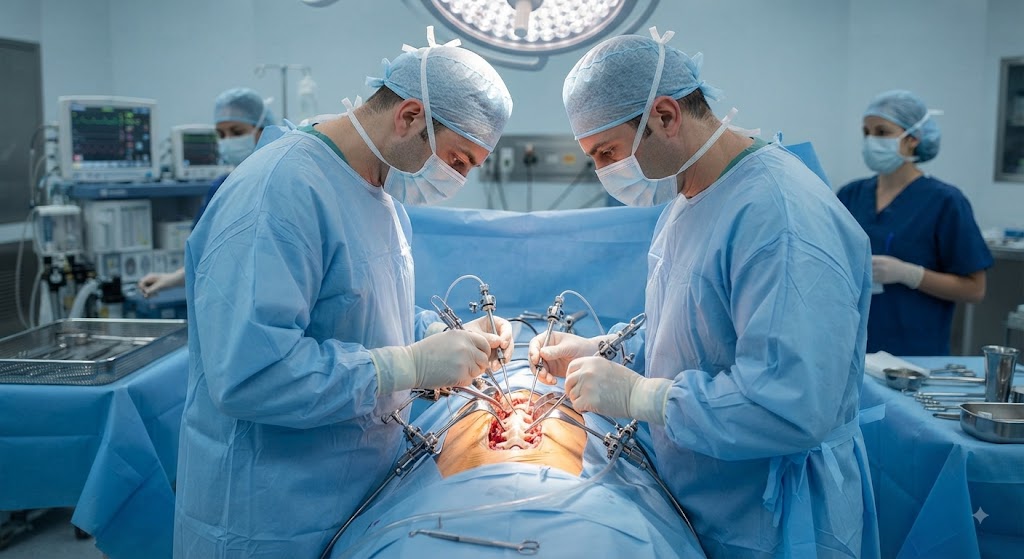
Spine Replacement Surgery by Brit Indo Medical Concierge
Spine replacement surgery is a commonly searched term for procedures that replace a damaged spinal disc with an artificial disc. Medically, this procedure is generally called artificial disc replacement (ADR) or disc arthroplasty. It may be performed in the cervical spine (neck) or lumbar spine (lower back) for carefully selected patients with painful disc disease.
Unlike spinal fusion, which joins two or more vertebrae together, artificial disc replacement is designed to preserve movement at the treated spinal level. It may be considered when symptoms continue despite appropriate non-surgical treatment.
Brit Indo Medical Concierge supports international patients considering spine surgery in India by coordinating medical consultations, hospital arrangements, treatment estimates, medical travel, accommodation and other non-clinical requirements.
What Is Spine Replacement Surgery?
- Spine replacement surgery usually refers to replacing a damaged intervertebral disc with an artificial disc.
- The damaged disc is removed and a specially designed implant is positioned between the vertebrae.
- The objective is to relieve pain caused by disc degeneration or nerve compression while maintaining movement at the treated level.
- Artificial disc replacement can be performed in selected cervical and lumbar spine conditions.
- It is different from spinal fusion surgery, where the affected vertebrae are joined together.
- The suitability of disc replacement depends on the patient’s diagnosis, spinal anatomy, imaging findings, symptoms and overall health.
Who May Need Artificial Disc Replacement?
A patient may be considered for artificial disc replacement surgery when spinal disc disease causes persistent symptoms and conservative treatment has not provided sufficient relief.
Common situations include:
- Degenerative disc disease causing chronic neck or lower-back pain.
- A herniated or damaged spinal disc causing pain or nerve symptoms.
- Persistent neck pain associated with cervical disc degeneration.
- Pain radiating from the neck into the shoulder, arm or hand.
- Lower-back pain associated with carefully selected lumbar disc disease.
- Numbness, tingling or weakness caused by nerve compression.
- Reduced mobility and difficulty performing everyday activities.
- Symptoms that continue despite appropriate physiotherapy, medicines, activity modification or injections.
- Imaging such as MRI or CT showing disc degeneration that matches the patient’s clinical symptoms.
Not every patient with back pain or a slipped disc needs surgery. A spine specialist must determine whether disc replacement, fusion, decompression or non-surgical treatment is the most appropriate option.
Types of Spine Replacement Surgery
Cervical Artificial Disc Replacement
- Cervical disc replacement is performed in the neck region of the spine.
- It may be considered for selected patients with symptomatic cervical degenerative disc disease or nerve compression.
- The damaged cervical disc is removed and replaced with an artificial disc.
- The aim is to relieve symptoms while maintaining movement at the treated level.
- Some patients may be candidates for one-level or selected multi-level procedures.
Lumbar Artificial Disc Replacement
- Lumbar disc replacement is performed in the lower back.
- It may be considered for selected patients with painful lumbar degenerative disc disease.
- The damaged disc is removed and replaced with an artificial disc designed to maintain motion.
- Lumbar disc replacement requires careful patient selection because the anatomy and surgical approach are different from cervical surgery.
Single-Level Disc Replacement
- Only one damaged spinal disc is replaced.
- It may be recommended when symptoms and imaging are linked primarily to one spinal level.
- Single-level surgery may involve a simpler treatment plan than multi-level surgery.
Multi-Level Disc Replacement
- Two or more affected spinal levels may be treated in selected patients.
- The suitability depends on the type and severity of disc disease and the patient’s overall spinal condition.
- Multi-level procedures may have different costs, risks and recovery requirements.
Hybrid Spine Surgery
- Hybrid surgery may combine artificial disc replacement at one level with spinal fusion at another level.
- It can be considered in selected patients with different types or degrees of disease at adjacent spinal levels.
- The surgeon decides whether a hybrid approach is appropriate after detailed imaging and clinical assessment.
Spine Replacement Surgery Cost: India vs UK vs USA
The spine replacement surgery cost varies considerably according to the spinal region, number of levels, implant, hospital, surgeon, technology, medical complexity and length of stay.
For international patients, indicative private/self-pay ranges can be used for initial planning:
| Procedure | India – Approx. | UK Private – Approx. | USA – Approx. |
|---|---|---|---|
| 1-Level Cervical Disc Replacement | US$5,000–$9,500 | £18,000–£35,000 | US$30,000–$65,000 |
| Lumbar Disc Replacement | US$6,000–$12,000 | £20,000–£45,000 | US$40,000–$70,000+ |
| 2-Level Cervical Replacement | US$8,000–$12,000+ | £28,000–£45,000+ | US$55,000–$95,000+ |
These are indicative comparison ranges, not fixed quotations. Published international estimates show substantial differences between countries, while Indian sources also report artificial disc replacement costs varying according to the implant and treatment plan.
For example, one Indian healthcare source reports approximately ₹4.5–8 lakh for cervical ADR and ₹6–10 lakh for lumbar ADR, while another source gives a broader Indian artificial disc replacement range of approximately ₹4–6 lakh. The difference demonstrates why patients should obtain an individual hospital quotation rather than rely on a single online price.
What Can Change the Treatment Cost?
The final spine surgery cost in India may depend on:
- Type of artificial disc implant.
- Cervical or lumbar procedure.
- One-level or multi-level surgery.
- Surgeon’s professional fees.
- Hospital and operating-room charges.
- Anaesthesia.
- Diagnostic tests and imaging.
- Hospital room category.
- Length of hospital stay.
- Physiotherapy and rehabilitation.
- Additional medical conditions.
- Complications or additional procedures.
- International-patient services and travel requirements.
Why Consider Spine Surgery in India?
India is an established destination for medical tourism, including orthopaedic and spine treatment.
Potential advantages for international patients include:
- Access to experienced spine surgeons and neurosurgeons.
- Modern private hospitals in major Indian cities.
- Availability of advanced diagnostic imaging.
- Access to different spinal implants and disc replacement options.
- Competitive treatment costs compared with many Western private healthcare systems.
- English-speaking medical professionals in many hospitals.
- International-patient departments at major hospitals.
- Integrated support for medical travel and hospital coordination.
The decision should always be based on medical suitability, surgeon expertise, hospital standards and expected outcomes—not price alone.
Before Spine Replacement Surgery
Proper preparation is an important part of the treatment journey.
Medical Assessment
Before artificial disc replacement surgery, the spine specialist may review:
- Complete medical history.
- Current symptoms and duration.
- Previous spine treatments.
- Physical and neurological examination.
- MRI scans.
- X-rays and, where appropriate, CT scans.
- Blood tests.
- Current medications.
- Previous operations.
- General fitness for anaesthesia.
- Bone health and other conditions that may affect surgery.
The specialist will determine whether the patient’s symptoms are actually caused by the damaged disc and whether disc replacement is suitable.
Preparing for Medical Travel to India
International patients may also need assistance with:
- Online spine surgeon consultation.
- Sending MRI and medical reports.
- Obtaining a preliminary treatment opinion.
- Receiving an estimated treatment package.
- Selecting a suitable hospital.
- Medical visa assistance where applicable.
- Flight itinerary planning.
- Airport transfers.
- Accommodation.
- Local transportation.
- Post-operative follow-up planning.
Brit Indo Medical Concierge can help coordinate these arrangements so that the patient’s medical journey is more organised.
During Spine Replacement Surgery
The exact procedure depends on whether the surgery is cervical or lumbar.
Generally, the process may involve:
- Admission to the hospital according to the surgeon’s instructions.
- Pre-operative checks and anaesthesia assessment.
- Administration of appropriate anaesthesia.
- A surgical approach to the affected spinal level.
- Removal of the damaged intervertebral disc.
- Decompression of affected nerves when required.
- Preparation of the disc space.
- Placement of the artificial disc implant.
- Imaging to confirm appropriate implant positioning.
- Closure of the surgical incision.
- Transfer to the recovery area for monitoring.
For cervical surgery, the surgeon may approach the spine from the front of the neck. A cervical disc replacement is one of the alternatives that may be discussed alongside fusion in appropriate patients.
After Spine Replacement Surgery
Recovery depends on the patient’s condition, surgical level, number of discs treated, general health and rehabilitation plan.
Immediately After Surgery
Patients may receive:
- Pain-management medication.
- Neurological monitoring.
- Wound-care instructions.
- Assistance with getting out of bed.
- Walking or mobility guidance.
- Physiotherapy when appropriate.
- Instructions regarding lifting, bending and twisting.
- Follow-up appointment arrangements.
Hospital stay varies according to the procedure and individual recovery. Some published Indian guidance indicates that many artificial disc replacement patients may stay approximately one to three days, although lumbar procedures and more complex cases may require longer stays.
Physiotherapy and Rehabilitation
Spine surgery rehabilitation may include:
- Gentle mobility exercises.
- Posture training.
- Core and back strengthening when medically appropriate.
- Walking programmes.
- Flexibility exercises.
- Gradual return to everyday activities.
- Workplace and ergonomic advice.
Patients should follow the specific restrictions provided by their surgeon rather than starting strenuous exercises independently.
Returning to Normal Activities
Recovery is different for every patient.
A return to:
- Desk work,
- Driving,
- Exercise,
- Lifting,
- Sports,
- Long-distance travel
should occur only according to the treating surgeon’s advice.
For cervical disc replacement, some patients may require a temporary neck collar and restrictions on heavy lifting during early recovery. Published NHS patient guidance advises following the surgeon’s specific instructions regarding exercises, lifting and follow-up.
Possible Benefits and Risks of Disc Replacement
Potential benefits of appropriately selected artificial disc replacement may include:
- Relief of neck or back pain.
- Reduction of nerve-related symptoms.
- Improved mobility.
- Preservation of movement at the treated spinal level.
- Potentially faster functional recovery compared with some fusion procedures.
However, surgery also has risks.
Possible complications can include:
- Infection.
- Bleeding.
- Blood clots.
- Nerve or spinal cord injury.
- Persistent pain.
- Implant movement or failure.
- Bone-related complications.
- Need for additional surgery.
- Anaesthesia-related complications.
The risks vary according to the procedure and patient. A detailed discussion with the treating spine surgeon is essential before treatment.
Spine Replacement vs Spinal Fusion
Patients frequently ask whether artificial disc replacement is better than spinal fusion.
The answer depends on the individual case.
- Artificial disc replacement: Designed to preserve movement at the treated spinal level.
- Spinal fusion: Joins the affected vertebrae to create a stable segment.
- Disc replacement may be appropriate for carefully selected patients.
- Fusion may be more appropriate when there is significant instability, advanced degeneration or other conditions that make disc replacement unsuitable.
- The surgeon should explain the expected benefits, limitations and risks of both options.
There is no single spine operation that is suitable for every patient.
How Brit Indo Medical Concierge Helps International Patients
Brit Indo Medical Concierge provides coordination support for patients travelling to India for spine treatment.
Our services can include:
- Initial treatment enquiry.
- Collection of medical reports and scans.
- Spine specialist consultation coordination.
- Hospital coordination.
- Treatment estimate assistance.
- Surgery scheduling support.
- Medical visa assistance.
- International air travel planning.
- Accommodation coordination.
- Airport transfer assistance.
- Local travel coordination.
- Post-treatment travel planning.
- Communication support between international patients and healthcare providers.
The goal is to make the medical tourism process in India easier to understand and more organised.
Frequently Asked Questions About Spine Replacement Surgery
1. What is spine replacement surgery?
Spine replacement surgery usually refers to artificial disc replacement, where a damaged spinal disc is removed and replaced with an artificial disc. It is different from replacing the entire spine and is performed in selected cervical or lumbar conditions.
2. How much does spine replacement surgery cost in India?
The approximate cost can vary from around US$5,000 to US$12,000 or more, depending on whether the procedure is cervical or lumbar, the implant, hospital, surgeon and complexity. Published Indian sources report different ranges, so patients should obtain a personalised quotation after medical evaluation.
3. Is artificial disc replacement better than spinal fusion?
Neither procedure is universally better. Artificial disc replacement is designed to preserve movement, while spinal fusion stabilises the affected segment. The appropriate option depends on the patient’s diagnosis, spinal anatomy and overall health.
4. How long does recovery take after disc replacement?
Recovery varies according to the spinal level, number of discs treated, surgical approach and individual health. Some patients gradually return to normal activities within weeks, while more demanding physical activities may require several months. The treating surgeon should provide the individual recovery timeline.
5. Can Brit Indo Medical Concierge arrange spine treatment in India?
Yes. Brit Indo Medical Concierge can assist international patients with medical consultation coordination, hospital arrangements, treatment estimates, medical visa assistance, air travel, accommodation and other medical-travel requirements. Clinical decisions are made by the qualified treating doctor and hospital.
Plan Spine Treatment in India with Brit Indo Medical Concierge
For patients searching for spine replacement surgery in India, understanding the diagnosis and available treatment options is the first step. Artificial disc replacement can be an option for carefully selected patients with specific cervical or lumbar disc conditions, but it is not appropriate for everyone.
Brit Indo Medical Concierge helps international patients coordinate the journey from specialist consultation and hospital selection to medical treatment, travel and accommodation.
Patients should always obtain an individual medical assessment before making travel or surgical decisions. Treatment prices, implant choices, hospital packages and recovery periods can change and should be confirmed directly with the selected healthcare provider.
Spine Replacement Surgery India, Spine Replacement Cost India, Artificial Disc Replacement India, Spinal Disc Replacement Surgery, Cervical Disc Replacement India, Lumbar Disc Replacement India, Spine Surgery India, Spine Surgeon India, Medical Tourism India
Artificial disc replacement, disc arthroplasty, degenerative disc disease, cervical spine surgery, lumbar spine surgery, herniated disc treatment, slipped disc surgery, spinal fusion, cervical disc implant, lumbar disc implant, spine surgery recovery, spine rehabilitation, nerve compression, spinal decompression, orthopaedic spine surgeon, neurosurgeon, medical visa assistance, international patient services, medical travel to India
Reviews
There are no reviews yet.