
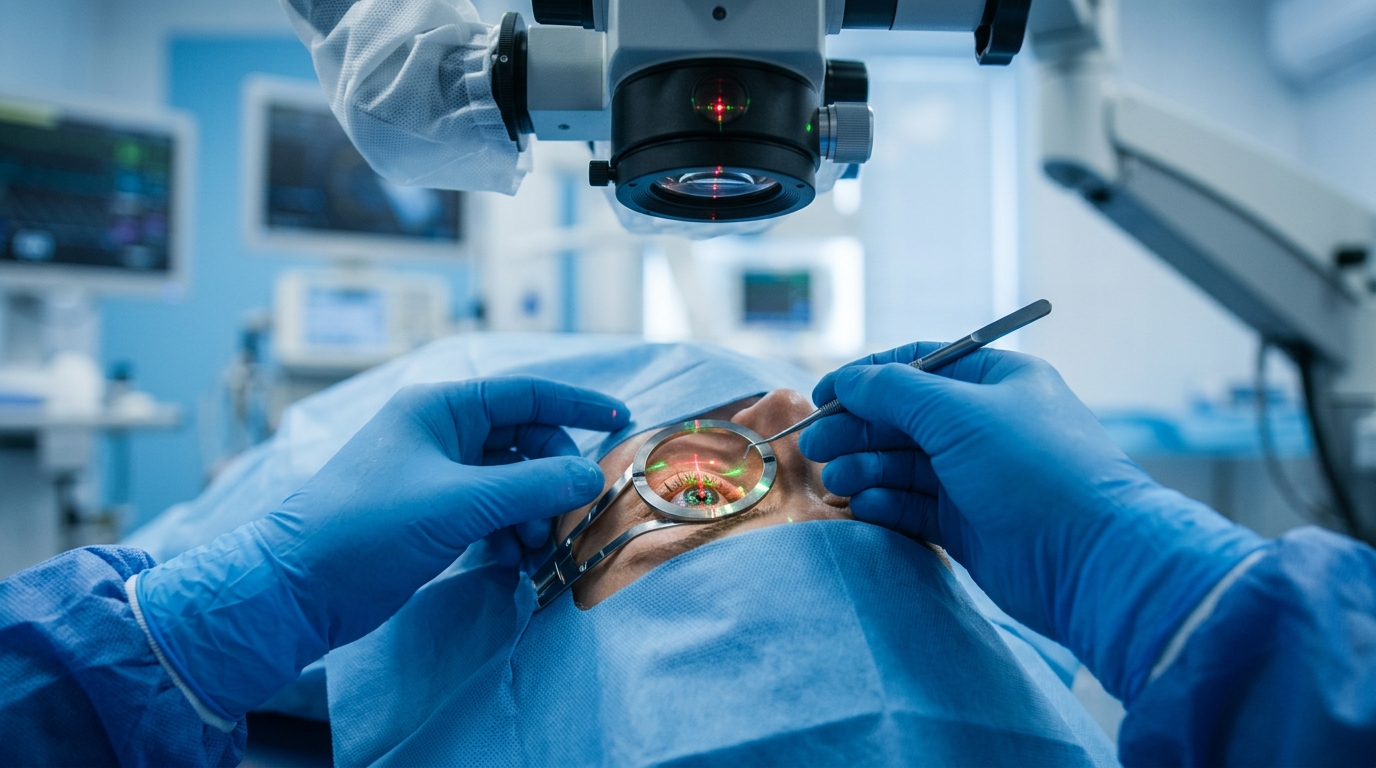
LASIK Eye Surgery by Brit Indo Medical Concierge
- LASIK eye surgery (Laser-Assisted In Situ Keratomileusis) is a popular laser vision correction procedure that reshapes the cornea to improve eyesight.
- It treats myopia (nearsightedness), hypermetropia (farsightedness) and astigmatism.
- Many patients reach 20/20 vision or close to it and reduce or stop using glasses and contact lenses.
- Brit Indo Medical Concierge helps patients from the UK, USA and other countries compare clinics, get quotes, and plan affordable LASIK surgery in India.
What Is LASIK Eye Surgery?
- LASIK is a quick outpatient eye surgery that takes about 10 to 15 minutes for both eyes.
- The surgeon creates a thin corneal flap, reshapes the corneal tissue with an excimer laser, then repositions the flap.
- The cornea bends light more accurately, so images focus properly on the retina.
- It is a refractive surgery, meaning it corrects how the eye focuses light.
- The flap heals naturally without stitches.
Who Needs LASIK Surgery?
Ideal Candidates
- Adults aged 18 or above (most clinics prefer 21+) with a stable prescription for at least 12 months.
- People with short-sightedness, long-sightedness or astigmatism within treatable limits.
- People tired of glasses dependency or contact lens discomfort.
- Those with healthy corneas, adequate corneal thickness and no active eye disease.
- Professionals such as pilots, sportspersons, defence aspirants and models who need clear vision without glasses.
- People in good general health with realistic expectations.
Who Should Avoid LASIK?
- Patients with keratoconus or a very thin cornea.
- Pregnant or breastfeeding women, because hormones can change vision.
- People with uncontrolled diabetes, autoimmune disease or severe dry eye syndrome.
- Those with glaucoma, cataract or recurrent eye infections.
- Anyone whose eye power keeps changing.
- Your ophthalmologist will confirm your eligibility after a detailed eye examination.
Types of LASIK and Laser Eye Surgery
Traditional (Conventional) LASIK
- Uses a microkeratome blade to create the corneal flap.
- Trusted for decades, with a good success rate and a lower price.
- Suitable for most standard prescriptions.
Femto LASIK (Bladeless LASIK)
- Uses a femtosecond laser to create the flap, so no blade is involved.
- Offers higher precision, safety and faster healing.
- Often called all-laser LASIK or iLASIK.
Custom Wavefront-Guided LASIK
- Maps your eye’s unique imperfections using wavefront technology.
- Gives sharper vision with fewer night-time glare and halos.
- A good option for high-order aberrations.
SMILE (Small Incision Lenticule Extraction)
- A minimally invasive laser procedure with a tiny 2 to 4 mm incision and no flap.
- Lower risk of dry eyes, and a good choice for active people.
- Usually costs more than standard LASIK.
PRK (Photorefractive Keratectomy)
- A surface laser treatment with no flap, where the outer layer is removed.
- Better for thin corneas, but recovery takes longer.
ICL (Implantable Collamer Lens)
- A phakic lens implant for very high prescriptions or thin corneas.
- Reversible, but it is a different kind of surgery from laser treatment.
LASIK Surgery Cost Comparison: India vs UK vs USA
Approximate prices per eye (clinic, technology and surgeon experience affect the final price):
| Country | Approx. Cost Per Eye | Approx. Both Eyes |
|---|---|---|
| India | ₹30,000 – ₹80,000 (about $360 – $960 / £290 – £760) | ₹60,000 – ₹1,60,000 |
| UK | £1,000 – £2,500 | £2,000 – £5,000 |
| USA | $1,500 – $3,000 | $3,000 – $6,000 |
- LASIK cost in India is often 60 to 80% lower than in the UK or USA.
- Lower cost does not mean lower quality. Leading Indian eye hospitals use FDA-approved lasers and internationally trained refractive surgeons.
- Most prices include pre-operative tests, surgery and follow-ups, but always confirm what is covered.
- Femto LASIK and SMILE cost more than conventional LASIK in every country.
- LASIK is usually considered cosmetic or elective, so insurance rarely covers it in the USA or UK.
- Savings can fund medical tourism travel and stay and still leave money to spare.
- Prices change often, so please request a personalised quote from Brit Indo Medical Concierge.
Before LASIK Surgery: Preparation Checklist
- Book a comprehensive eye test covering corneal topography, pachymetry, pupil size, eye pressure and dry eye assessment.
- Stop wearing contact lenses: 1 to 2 weeks for soft lenses, and 3 to 4 weeks for hard or toric lenses.
- Share your medical history and medications with your surgeon.
- Ask about the laser technology, flap type and expected results.
- Avoid eye makeup, creams, perfume and lotions on the day of surgery.
- Arrange a companion to take you home afterwards.
- Wear comfortable clothes and eat lightly.
- Medical tourists should plan to stay in the city for 3 to 7 days for check-ups.
During LASIK Surgery: Step-by-Step Procedure
- Numbing eye drops are applied, so you feel no pain, only slight pressure.
- A small eyelid holder keeps your eye open.
- The surgeon creates a thin corneal flap with a femtosecond laser or microkeratome.
- You look at a fixation light while the excimer laser reshapes the cornea in seconds.
- The flap is gently repositioned and heals without stitches.
- The whole LASIK procedure takes about 10 to 15 minutes.
- You may see blurry or hazy vision right after, and many people notice a big improvement within hours.
After LASIK Surgery: Recovery & Aftercare
- Rest your eyes for the first 24 hours, and sleep if you can.
- Use prescribed eye drops (antibiotic, steroid and lubricating drops) exactly as directed.
- Wear protective eye shields at night for about a week.
- Do not rub your eyes, as this can displace the flap.
- Avoid swimming, saunas, dusty places and eye makeup for 1 to 2 weeks.
- Limit screen time at first, and take regular breaks.
- Skip contact sports and heavy gym workouts for 2 to 4 weeks.
- Attend all follow-up visits (usually day 1, week 1 and month 1).
- Dry eyes, glare and halos are common early on and usually improve in weeks to months.
- Most people return to work in 1 to 3 days, with stable vision in about 3 to 6 months.
Risks and Side Effects to Know
- Dry eyes (the most common effect, usually temporary).
- Night vision problems such as glare, halos and starbursts.
- Under-correction or over-correction, which may need an enhancement procedure.
- Rare issues include infection, flap complications and regression.
- Choosing an experienced LASIK surgeon and a well-equipped eye centre greatly lowers these risks.
Why Choose Brit Indo Medical Concierge?
- Guidance on choosing top LASIK eye hospitals and experienced ophthalmologists.
- Transparent cost estimates with no hidden surprises.
- Help with appointments, travel, accommodation and local transport.
- Pre-surgery and post-surgery support for international patients.
- A smooth medical tourism experience built around your comfort and safety.
Frequently Asked Questions (FAQs)
1. Is LASIK eye surgery safe and painful?
- LASIK is considered safe for suitable candidates, with high satisfaction rates.
- It is not painful because numbing drops are used. You may feel pressure or mild irritation afterwards.
2. How long do LASIK results last?
- Results are generally long-lasting, often permanent.
- Natural ageing can still cause presbyopia (reading glasses need after 40s) and later cataracts, which LASIK does not prevent.
- A small number of people need a touch-up after some years.
3. Is LASIK cheaper in India than in the UK or USA?
- Yes. LASIK in India costs about 60 to 80% less than in the UK or USA.
- Modern laser technology and skilled surgeons are available at lower prices, which is why many overseas patients choose LASIK in India.
4. How soon can I see clearly and resume normal life?
- Many people notice clearer vision within 24 hours.
- You can usually return to work in 2 to 3 days and drive once your surgeon approves.
- Full vision stabilisation may take a few months.
5. What is the difference between LASIK, SMILE and PRK?
- LASIK uses a corneal flap and offers quick recovery.
- SMILE is flapless with a tiny incision and less dry eye risk.
- PRK removes the surface layer, suits thin corneas, and takes longer to heal.
- Your eye specialist will recommend the best option for your eyes.
Final Thoughts
- LASIK eye surgery can free you from glasses and contact lenses with a short, safe procedure.
- Compare LASIK cost, technology, surgeon experience and aftercare before deciding.
- With expert support from Brit Indo Medical Concierge, you can get quality laser eye treatment at an affordable price.
- Contact the team for a free consultation and personalised LASIK quote today.
Reviews
There are no reviews yet.